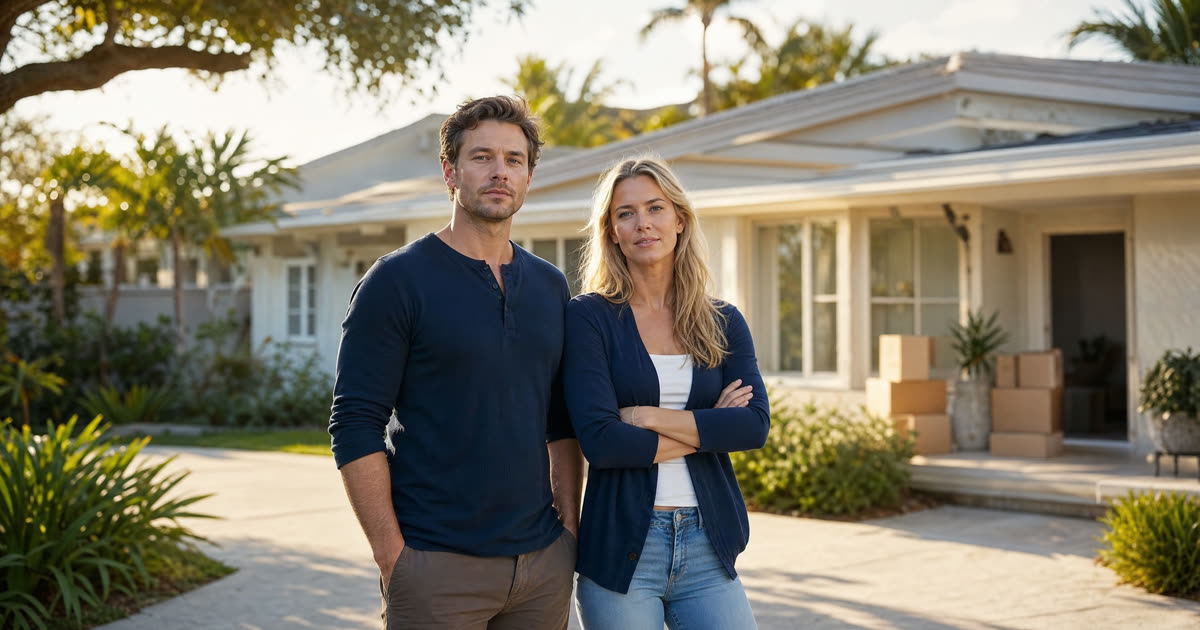
Karen Was in Columbus. The House Was in Ormond Beach. Here Is What She Did.
Karen's father passed away earlier this year, leaving behind a modest ranch house near the Halifax River in Ormond Beach. She lives in Columbus, Ohio. Her brother lives in Newark, New Jersey. Neither of them had any intention of relocating to Florida, but both understood that the house represented real value, and that selling it promptly was the right move for the estate. Their first question was a practical one: do we actually have to travel there to get this done?
The short answer is no, not for most of it. The longer answer is what this article is about. (Karen and her brother are a composite example, not actual clients, offered here to illustrate a process that many families in exactly this situation face every year.)
For the full legal and financial framework behind any inherited Florida sale, see the complete guide to selling an inherited house in Florida. This piece focuses on a single question: how do out-of-state heirs manage the probate and sale without getting on a plane?
Step One: Confirm Whether Probate Is Required
Because Karen's father held the Ormond Beach home in his name alone, with no co-owner and no lady bird deed, no revocable trust, and no joint tenancy with right of survivorship, the property cannot transfer to the heirs without going through the Florida probate system. That is the threshold rule for any home titled only in a decedent's name. Florida probate is handled in the circuit court of the county where the property sits, which in this case is Volusia County.
The first question the court will resolve is which type of probate applies. Florida summary administration is available when the total value of probate assets, excluding exempt property, does not exceed $150,000 for deaths occurring on or after July 1, 2026 (the threshold was $75,000 before that date), or when the death occurred more than two years ago. Formal administration applies in all other cases. Karen's father's estate, counting the home and a small bank account, exceeded that threshold, so the family moved forward with formal administration in Volusia County Circuit Court.
The Nonresident Personal Representative Rule
Under Florida Statutes section 733.304, a nonresident of Florida may serve as personal representative only in limited circumstances: as a legally adopted child or adoptive parent of the decedent, as a relative by lineal consanguinity, as a spouse or a sibling, or as a spouse of a person otherwise qualified. Karen, as a daughter, qualifies. Her brother, as a son, also qualifies. Either of them could serve.
They appointed Karen as the sole personal representative. She did not need to appear in person at the courthouse to be appointed. The petition, supporting documents, and oath were all prepared by a Florida probate attorney and executed remotely using Florida's remote online notarization system. Florida has authorized remote online notarization since 2020, and notarial acts performed through an approved platform, with the signer appearing live on video and identity verified electronically, carry the same legal weight as in-person notarizations. Karen signed and notarized her paperwork at her kitchen table in Columbus.
Once the court issued Letters of Administration, Karen had the legal authority to act on behalf of the estate, including the authority to list and sell the Ormond Beach property.
Local Representation on Both Sides: Legal and Real Estate
Managing a sale from out of state does not mean managing it alone. Karen engaged both a Florida probate attorney and a local REALTOR who understood the Volusia County market. Because Arthur Simpson operates both Truestead Law, LLC for the legal side and his REALTOR practice with Realty Pros Assured in Ormond Beach, families in Karen's position can coordinate the probate and the sale through a single point of contact, which reduces confusion and avoids the delays that often arise when the attorney and the agent are working in silos.
From a pricing standpoint, the current Volusia County market demands realistic expectations. The median home price in the county is down roughly four percent year-over-year, inventory has surged fifty to seventy percent in communities like Daytona Beach and Deltona, and homes are sitting on the market an average of sixty to seventy days before going under contract. The list-price-to-sale-price ratio has settled in the ninety-seven to ninety-nine percent range, a significant change from the peak years of 2021 and 2022. For an estate that needs to sell rather than wait, pricing at or just below market from the outset typically produces the best result. Overpricing an inherited home in a buyer's market tends to extend the listing period, which compounds the carrying costs the estate must absorb.
Managing the Property While Probate Proceeds
A vacant house in Ormond Beach, Port Orange, or Palm Coast is not a passive asset. It needs attention. Karen and her brother arranged the following before the home was listed:
- Vacant home insurance: Standard homeowner policies often exclude or limit coverage once a property has been unoccupied for thirty to sixty days. Karen's attorney flagged this early, and the estate obtained a vacant dwelling policy to cover the property through closing.
- Property check service: A local property management company conducted periodic walkthroughs and reported back by email. This caught a slow leak under the bathroom sink before it became a disclosure problem.
- Estate cleanout: Karen hired a local estate sale company to liquidate the personal property. The physical cleanout was handled by a Volusia County junk removal service. Karen directed everything by phone and email, reviewed photos and invoices, and paid vendors electronically. She never traveled.
- Utility accounts: Power and water stayed active until closing to allow showings and inspections. Karen managed the accounts online.
Want answers for your exact situation? Get 30 minutes with an Attorney & REALTOR®. It's free.
Book a Free Strategy Call or call/text 386-273-3636Showings and Inspections from Afar
Karen's REALTOR managed every showing. Because she was not present, the home used a lockbox, and the REALTOR was available to answer agent and buyer questions in real time. Inspection appointments were scheduled directly between the inspector and the listing agent. The inspection report was uploaded to a shared folder, and Karen reviewed it with her attorney and agent on a video call the same afternoon it was delivered.
When repair requests came in during negotiation, Karen and her brother made decisions by text and email. A licensed local contractor provided written estimates, which the estate used to counter with a credit rather than agreeing to repairs, a common and practical approach when the personal representative cannot supervise the work.
Wire Fraud: The Risk Nobody Warns You About
Out-of-state sellers are a prime target for real estate wire fraud. The scheme typically works like this: a fraudster monitors email communications related to the closing, impersonates the title company or closing agent, and sends the seller revised wiring instructions to redirect funds. Because out-of-state heirs are already accustomed to conducting everything by email, they may not question a message that looks legitimate.
Karen's closing agent gave her clear instructions at the outset: verify wiring instructions by calling the title company directly at a phone number she looked up independently, not one provided in an email. Any last-minute change to wiring instructions is a red flag and should be treated as presumptively fraudulent until confirmed by voice with a known contact. For inherited estates, where the personal representative may have limited familiarity with the closing process, this warning is worth repeating more than once.
Remote Closing: How Karen Signed Without Flying
Florida allows sellers to close remotely. Karen had two options. The first was a mail-away closing, in which the title company overnights a closing package, Karen signs before a local notary in Ohio (or uses a remote online notary), and she overnights the documents back. The second was a fully remote online closing using a Florida-approved remote online notarization platform, in which every document is signed and notarized live on video. Karen used the remote online notarization option. Her brother, who was not a party to the sale itself (Karen acted as personal representative), did not need to sign closing documents.
Proceeds were wired directly to the estate account Karen had opened in Columbus. Florida imposes no state income tax and no state estate or inheritance tax, so the estate's federal obligations, primarily the question of capital gains on any appreciation above the stepped-up basis the property received at her father's death, were the only tax considerations. For more on how the stepped-up basis works, see the article on capital gains on inherited property in Florida.
What This Meant for Karen and Her Brother
From the date Letters of Administration were issued to the date the wire hit the estate account, the process took just under five months. Karen traveled to Florida exactly once, briefly, to retrieve a few personal items she wanted to keep. Everything else, from the probate filings to the remote online notarizations to the closing itself, was handled without either heir relocating or taking extended leave from work.
Her brother, inheriting as a tenant in common with Karen through the estate distribution, received his share of the net proceeds once the estate was settled. Because the siblings agreed on the sale from the beginning, there was no need to consider a partition action under Chapter 64 of the Florida Statutes, though that remedy exists when co-heirs cannot reach agreement. For a deeper look at that scenario, the article on what happens when one heir wants to sell and another does not explains the options.
The Ormond Beach house sold in the high two-hundred-thousands, close to asking price, within the first thirty days of listing. The pricing strategy, realistic from the start given current Volusia County conditions, made the difference.
You Do Not Have to Figure This Out Alone
If you have inherited a Florida home and you live in Ohio, New Jersey, Georgia, New York, or anywhere else outside the state, you have more options than you may realize. The probate process, the listing, the cleanout, the negotiation, and the closing can all be managed remotely with the right local team in place.
Arthur Simpson, Esq., CIPS is an Attorney and REALTOR with Realty Pros Assured in Ormond Beach and founder of Truestead Law, LLC. He works with out-of-state heirs throughout the Daytona Beach area, Ormond Beach, Port Orange, New Smyrna Beach, Palm Coast, DeLand, and across Volusia and Flagler counties. Reach out at arthursimpson.com to talk through your situation and get a clear picture of what comes next.