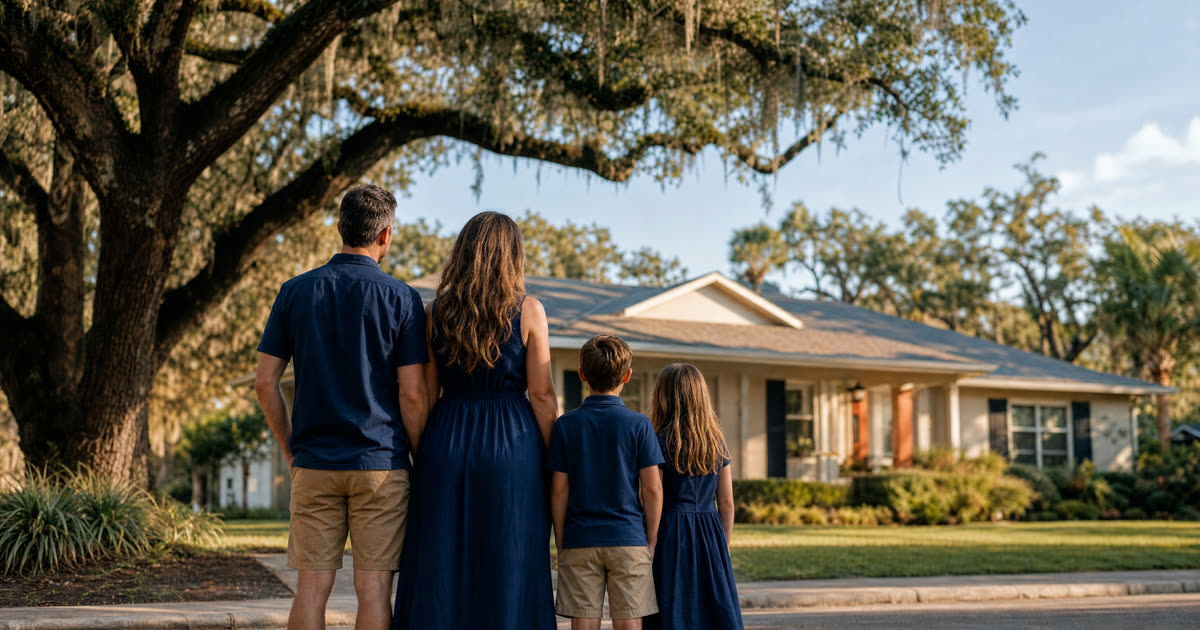
One Buyer, Two Counties, One Decision
Lena is 46, a registered nurse, and she just accepted a position at AdventHealth Palm Coast. She has family in Daytona Beach, a budget she has thought through carefully, and a specific image in her head: a canal-front home where she can keep a small boat, watch herons from the lanai, and still reach her sister in twenty minutes. The problem is that two very different markets are each telling her they are the right answer. Palm Coast is offering newer construction, wider lots, and saltwater canals that connect to the Intracoastal. Ormond Beach is offering established neighborhoods, coastal character, and a location that keeps her closer to family without requiring a move into Flagler County. Both markets have real merit. The differences between them are real too, and they run deeper than price.
Lena is a composite, not a client, but her situation mirrors conversations that come up regularly when buyers cross the Volusia-Flagler county line in either direction. This guide walks through what actually changes when you make that crossing.
Two Cities, Two County Governments, Two Tax Structures
Palm Coast sits in Flagler County. Ormond Beach sits in Volusia County. That sentence sounds simple, but it carries real consequences for a buyer. Each county has its own property appraiser, its own millage rates set by the county commission and the local municipality, and its own special assessment districts. You are not comparing two neighborhoods; you are comparing two separate governmental and fiscal frameworks.
Florida property taxes begin with an assessed value determined by the county property appraiser, not by the purchase price alone. Under Florida Statute 193.155, a homestead property's assessed value may increase by no more than three percent per year or the rate of inflation, whichever is lower. That is the Save Our Homes cap, and it applies once you file for homestead exemption under Florida Statute 196.031. The first twenty-five thousand dollars of assessed value is exempt from all taxes, and an additional twenty-five thousand dollars is exempt from non-school millage. The cap is valuable over time, but it only protects you after the first year, and the millage rates in Flagler and Volusia are each set independently. Neither county is dramatically more expensive than the other in broad terms, but the difference in your specific tax bill depends on your assessed value and the overlapping millage of the city, county, school board, and any special taxing district that covers your parcel. Ask your REALTOR to pull the current tax bill for any property you consider, and verify that you are looking at the taxed owner's situation, not what yours will be after reassessment at your purchase price.
Palm Coast is notably different from most Florida cities in one important way. It was designed. The community grew from the General Development Corporation's master plan of the 1960s and 1970s, and it is organized into lettered sections, each with its own character. The infrastructure of canals, lakes, and greenways was built into the plan from the start. Ormond Beach, by contrast, grew organically over more than a century. Its streets wind around live oaks and old lot lines, and its character varies block by block in a way that no diagram can fully capture.
Palm Coast: Canal Homes, Planned Sections, and New Construction
The saltwater canals in Palm Coast's C, F, and R sections connect directly to the Intracoastal Waterway and are a genuine draw for boaters. Homes on these canals typically have private docks, and the ability to go from your backyard to open water without a trailer is something buyers pay a meaningful premium to have. The Zillow Home Value Index for Palm Coast put the typical home value at $345,000 in July 2026, down about 1.8 percent over the prior year but up nearly 12 percent over five years. Flagler County as a whole showed a typical value of $352,000 in the same index.
Inventory in Palm Coast has expanded. There are significantly more active listings than a year ago, and homes are sitting longer before going under contract. That is not necessarily bad news for a buyer. It means more choices, more room to negotiate, and less pressure to waive contingencies. Lena noticed quickly that she could be more deliberate in Palm Coast than she might have been able to be twelve to eighteen months ago.
New construction is plentiful. Several national builders are active in Palm Coast, and move-in-ready homes with warranties and modern floor plans are available at prices that would not be possible in most of coastal Florida. That is part of the appeal. The tradeoff is that newer communities are still maturing. Landscaping takes years to grow in. Retail and medical infrastructure in newer sections can require a longer drive than the lot's address might suggest. AdventHealth Palm Coast is located on Palm Coast Parkway, which puts it within a reasonable drive of most sections, though some of the outer planned areas add time to that commute.
Canal-front homes in Palm Coast carry specific insurance considerations that Lena spent real time thinking about. A home on a saltwater canal connected to the Intracoastal is almost certainly in a FEMA Special Flood Hazard Area. Flood insurance is a separate policy from homeowners insurance, and the premium is driven by the flood zone designation, the structure's elevation relative to the Base Flood Elevation, and the coverage amounts selected. Elevation certificates matter enormously here. A home elevated well above the Base Flood Elevation on a canal can carry a manageable flood premium. A home at or below it can carry a premium that changes the entire economics of ownership. This is not something to review after going under contract. It is something to research before making an offer.
Want answers for your exact situation? Get 30 minutes with an Attorney & REALTOR®. It's free.
Book a Free Strategy Call or call/text 386-273-3636Ormond Beach: Established Core, Beachside Character, and Coastal Proximity
Ormond Beach is where Flagler planted his railroad and Rockefeller built a winter retreat. The city has layers that Palm Coast simply does not have yet, and those layers show up in the housing stock. You find concrete block homes from the 1950s and 1960s alongside renovated mid-century ranches, newer infill construction, and older beachside cottages east of A1A. The typical home value in Ormond Beach was $367,000 in July 2026, per the Zillow Home Value Index, down about 2.2 percent over the prior year but up nearly 16 percent over five years. Volusia County as a whole showed a typical value of $327,000.
Inventory in Ormond Beach is tighter than in Palm Coast. Fewer homes are listed, and the supply has contracted slightly compared to a year earlier. Buyers in Ormond face more competition for desirable properties, particularly on the barrier island east of the Halifax River and in the established west-side neighborhoods near Granada Boulevard and Tymber Creek Road.
For Lena, the Ormond Beach case comes down to two things: family and familiarity. Her sister lives in Daytona Beach, and the drive between the two cities is short in a way that Palm Coast simply cannot match. The two cities share a border. AdventHealth Palm Coast requires a longer drive from Ormond, running north on I-95 or along U.S. 1, and that commute is real and daily. But the trade is proximity to family, proximity to the beach, and a city with a fully developed commercial and medical infrastructure that she already knows.
Ormond Beach also has beachside blocks east of A1A where flood zone exposure is significant, and buyers there face the same flood insurance calculus as canal buyers in Palm Coast. Homes away from the ocean and river on Ormond's west side are generally in lower-risk flood zones, though buyers should always verify the specific flood zone of any parcel through FEMA's Flood Map Service Center and confirm with an elevation certificate before assuming a low premium.
What Buyers Should Review Before Going Under Contract
Regardless of which city a buyer chooses, Florida law provides a framework that protects buyers who use it correctly. The Florida Realtors/Florida Bar AS IS Residential Contract for Sale and Purchase, which is the standard form used across the state, includes an inspection period during which a buyer may cancel for any reason and receive a return of the deposit. That period is negotiable, but it is the buyer's primary window for investigating the property's physical condition, flood zone status, insurance costs, and any association documents.
- HOA and condominium association documents must be reviewed before contract if possible, and estoppel certificates from the association are required to confirm the seller's account status and any outstanding assessments under Florida Statute 720.30851 for HOAs and Florida Statute 718.116 for condominiums.
- Condominium buildings of three stories or more are subject to Florida's milestone inspection requirements and structural reserve funding rules enacted after the Surfside collapse, and buyers of those units should review current inspection reports and reserve study disclosures carefully.
- Short-term rental rules differ between Palm Coast and Ormond Beach, and buyers who intend to rent a property on a short-term basis should verify local ordinances before assuming the use is permitted.
- Documentary stamp taxes on the deed are paid by the seller in most Florida transactions, but the buyer pays doc stamps on any new mortgage note at 35 cents per $100, along with intangible tax on the note at 2 mills. These are real closing costs that belong in the buyer's budget from the beginning.
The attorney-REALTOR read, meaning a careful legal and factual review of the contract, the title commitment, the survey, the flood zone determination, the HOA documents, and the insurance quotes, is not optional for a buyer making a decision of this size. It is the work that turns a hopeful purchase into a sound one.
What Lena Chose
Lena chose Ormond Beach, and she did not choose it reluctantly. After spending several weekends driving both markets, she concluded that the daily commute to AdventHealth Palm Coast was manageable in a way she had initially underestimated, particularly working shifts that let her avoid the peak of morning traffic on I-95. More important to her was the realization that family proximity was not a lifestyle preference she was willing to compromise. Being twenty minutes from her sister rather than forty-five was worth more to her than a canal dock.
She purchased a renovated block home in Ormond's established west-side core, in a flood zone that allowed for a standard homeowners policy without a separate flood policy required by her lender. The home is older than anything she looked at in Palm Coast, and she will need to budget for some deferred maintenance, but the lot is mature, the neighborhood is quiet, and she can walk to a coffee shop on Granada. She reviewed the title commitment, confirmed there was no HOA, and verified the flood zone independently before removing her inspection contingency.
Palm Coast was not wrong for her. It was simply less right than Ormond. For a different buyer, one who prioritizes a boat, a newer home, or a lower purchase price over commute and family proximity, the answer might run exactly the other way.
Ready to Compare Both Markets With Someone Who Knows Both Counties?
Arthur Simpson, Esq., CIPS, is an Attorney and REALTOR® with Realty Pros Assured in Ormond Beach. He works with buyers across Volusia and Flagler counties and brings a legal perspective to every step of the transaction, from flood zone review to contract negotiation to closing. If you are weighing Palm Coast against Ormond Beach, or any other pairing in this region, visit arthursimpson.com to start the conversation.