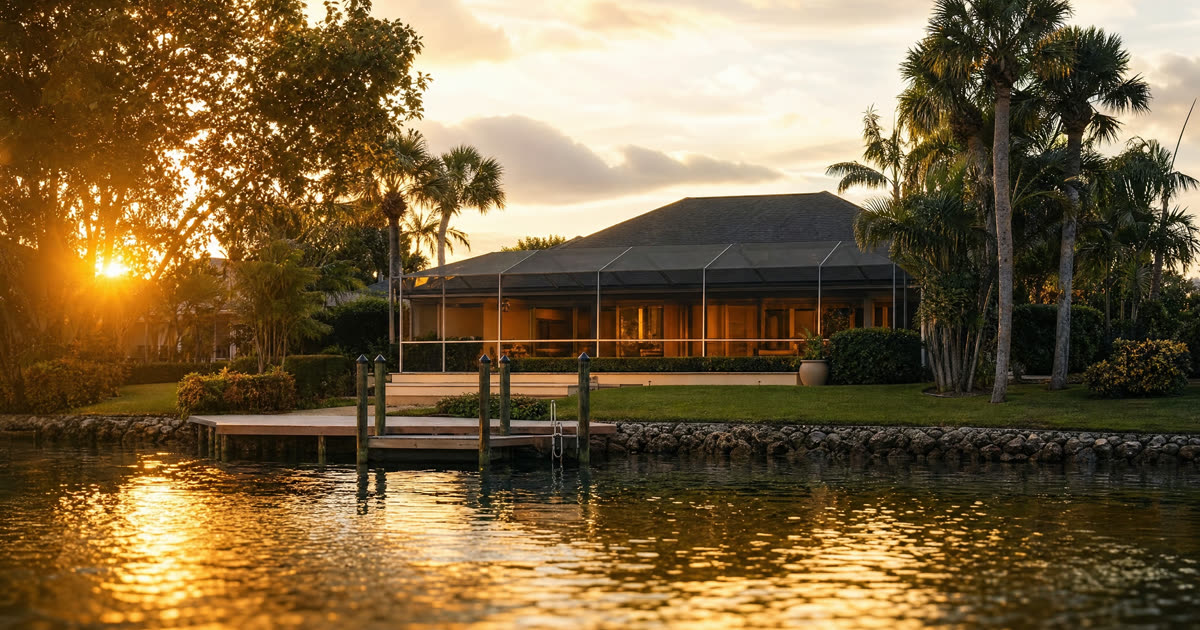
Two Boaters, Three River Towns, and One Big Decision
Mark and Julie had done their research. At 49 and 47, they were done renting slips at the marina and ready to own a home where they could step off the back porch, untie the lines, and head out on the water. They knew they did not want ocean frontage. They wanted the river: calm mornings, protected anchorage, and a private dock. What they did not know, at first, was how much the words "riverfront" and "waterfront" could mean different things depending on the street, the county zone, and the fine print in a survey. Mark and Julie are a composite, not a specific client, but their questions are real ones that serious buyers ask every season along the Halifax and the Intracoastal.
This guide answers the question they brought to the table: which river towns in Volusia County make sense for a boating couple, and what does waterfront ownership actually cost beyond the purchase price?
The Waterways: Halifax River Versus the Intracoastal
Volusia County sits along two distinct navigable waterways, and the difference matters for boaters. The Halifax River runs from Daytona Beach north through Ormond Beach, a broader, more sheltered stretch that locals have used for recreation and commerce for well over a century. South of Daytona, the waterway narrows and transitions into what is more formally part of the Atlantic Intracoastal Waterway, passing through Port Orange and continuing down through Edgewater and New Smyrna Beach before reaching Ponce de Leon Inlet.
Ponce Inlet is the key geographic fact for a boater choosing a home address. It is the only Atlantic inlet in this stretch of coast, and your distance from it shapes how quickly you can reach open water. A home on the Halifax north of Daytona means more river miles to the inlet. A home in Port Orange or Edgewater puts you closer, with fewer bridges to clear and a shorter run south. Mark, who runs a center-console and occasionally takes it offshore, kept a rough mental note of that distance during every showing.
Three Towns, Three Price Points
Before waterfront premiums, bridge heights, and seawall conditions, the baseline home values in these towns differ meaningfully. According to the Zillow Home Value Index for July 2026, the typical home value in Ormond Beach is $367,000, which is above the Volusia County typical value of $327,000. Port Orange comes in at $340,000, also above the county median, while Edgewater sits at $297,000, below the county figure. New Smyrna Beach, for reference, carries a typical value of $455,000, the highest of any town in this comparison.
Those are baseline figures for all homes. Riverfront or canal-front properties carry a premium above those baselines, and that premium varies based on lot depth, seawall condition, dock permits, navigability, and proximity to the inlet. The gap between a waterfront lot and a standard lot in the same zip code is not fixed; it reflects the specific features of each parcel.
One-year trends show modest softening across all three towns: Ormond Beach is down 2.2%, Port Orange down 3.1%, and Edgewater down 1.0% over the prior year. Five-year appreciation tells a different story, with all three well above the county baseline, particularly Edgewater at 20.2% and Ormond Beach at 15.9%. Buyers in 2026 are entering at a more favorable point in the cycle than buyers who transacted in 2022 or 2023.
Docks, Riparian Rights, and Sovereign Submerged Lands
This is the section most riverfront buyers underestimate. Owning land on the water in Florida gives you riparian rights, meaning the right of access to and use of the water adjacent to your property. But the submerged land beneath the river is generally owned by the State of Florida, held in trust for the public under Chapter 253 of the Florida Statutes. Building a dock, a boathouse, or any fixed structure over that submerged land requires a lease or easement from the Florida Department of Environmental Protection, typically administered through the Board of Trustees of the Internal Improvement Trust Fund.
In practical terms, this means a dock that exists on a property you are buying should have documentation: the original DEP lease or letter of consent, any subsequent modifications, and confirmation that the lease is current and transferable. A dock that was built without permits, or expanded beyond the permitted footprint, is a liability that transfers with the deed. The seller's disclosure form (the Florida Residential Contract for Sale and Purchase uses the AS IS version in most transactions today) requires disclosure of known defects, but sellers do not always know what they do not know about permits pulled decades ago.
Mark and Julie learned early to ask one question at every showing: can you show us the dock permit? The answer told them a great deal about how carefully the current owners had maintained the property.
Dock permitting in Volusia County also involves the Army Corps of Engineers for structures over navigable waters, and local county or city building departments for construction on the upland portion. The process is layered, and the timeline for a new dock permit can run from several months to well over a year depending on environmental review, structure size, and whether the project triggers mitigation requirements. Buyers purchasing a home without an existing dock should not assume one can be added quickly or inexpensively.
Seawalls: The Inspection No One Wants to Skip
A seawall separates your yard from the water and, in many cases, supports the structural integrity of the lot itself. Seawalls in this region are commonly made of concrete, vinyl, or older coquina-and-mortar construction, and they have finite lifespans. A failing seawall shows signs that include tilting, cracks at the cap, soil erosion behind the wall, and undermining at the base. Replacement costs are substantial, and they are rarely covered by standard homeowners insurance.
A standard home inspection does not always include a thorough seawall evaluation. Buyers should request a marine survey or a seawall-specific inspection from a qualified inspector. For homes where the dock is also being relied upon, a separate marine survey of the dock structure, pilings, and connections is a reasonable and prudent step. Julie, an experienced boater, knew what deteriorating pilings looked like from the water. She made it a habit to arrive at showings early and walk the seawall line before the agent unlocked the door.
Want answers for your exact situation? Get 30 minutes with an Attorney & REALTOR®. It's free.
Book a Free Strategy Call or call/text 386-273-3636Flood Insurance and FEMA Zones on the River
Flood insurance is separate from homeowners insurance and is governed by FEMA's National Flood Insurance Program, with private market alternatives now available in Florida. Properties along the Halifax and the Intracoastal fall into a range of flood zones: Zone AE (high-risk, with a base flood elevation established), Zone X (lower risk, where flood insurance is not federally required for conventional loans but is still advisable), and in some areas Zone VE, though VE is more common on the barrier island side.
For riverfront homes specifically, Zone AE is common, and the flood insurance premium is driven heavily by the structure's elevation relative to the base flood elevation shown on the FEMA Flood Insurance Rate Map. An elevation certificate, prepared by a licensed surveyor, documents this relationship. A home built high on a seawall lot with significant freeboard above the base flood elevation will carry a meaningfully lower premium than one where the first finished floor sits near or below that elevation. Buyers should request the elevation certificate before making an offer, or commission one as part of due diligence.
Florida law requires sellers to disclose known flood damage history. Under Section 689.302, Florida Statutes, residential sellers must provide written disclosure of any known flood damage, and since 2024 legislative updates, disclosure requirements around FEMA flood zone status have been strengthened. An attorney-REALTOR® review of the seller's disclosure statement alongside the elevation certificate and the FIRM map panel is the right sequence, not an afterthought.
The Full Cost of Waterfront Ownership
Buyers who focus on the purchase price alone consistently underestimate riverfront carrying costs. The full picture includes:
- Flood insurance, which is separate from homeowners insurance and driven by zone and elevation
- Windstorm coverage, which in Florida is often a separate policy or rider from Citizens or the private market
- Seawall maintenance and eventual replacement, which is the homeowner's responsibility on the upland side
- Dock maintenance, including piling inspection and periodic decking replacement
- DEP lease renewal if the dock is on sovereign submerged lands
- Property taxes assessed by the Volusia County Property Appraiser, with the homestead exemption and Save Our Homes cap available to permanent residents under Section 196.031 and Section 193.155, Florida Statutes
- HOA or deed restriction fees in planned communities, which vary and should be reviewed in the association documents before contract
The waterfront premium is real, and so are the ongoing costs. Buyers who model those carrying costs honestly before writing an offer make better long-term decisions.
The Attorney-REALTOR® Read on Surveys, Permits, and Documents
Waterfront transactions have more moving parts than a standard residential closing. A boundary survey showing the mean high water line and any encroachments is essential. The dock permit history, the DEP lease if applicable, the elevation certificate, the seawall inspection, the title search for any riparian right disputes or easements, and the HOA or deed restriction review all belong in the due diligence period, not after closing.
The Florida AS IS Residential Contract for Sale and Purchase provides an inspection period during which buyers may cancel for any reason and recover their deposit. That window is the time to complete every one of those reviews. Short-term rental rules, for buyers who want the flexibility to rent the home when not in use, differ by city and should be confirmed with each municipality before relying on projected rental income in a purchase decision.
Having an attorney who is also a licensed REALTOR® means the same professional who negotiates your contract, reviews the seller's disclosures, and advises on title can also read the dock permit file and flag a sovereign submerged lands issue before it becomes a closing problem. That dual lens is particularly valuable in waterfront transactions.
What Mark and Julie Chose
After four months of searching, Mark and Julie chose Port Orange. The decision came down to several overlapping factors. The typical home value in Port Orange, $340,000 per the Zillow Home Value Index for July 2026, gave them a slightly lower baseline than Ormond Beach, and the waterfront lots they toured in the southern end of town were priced more accessibly than comparable Halifax-front properties to the north. The run to Ponce Inlet was shorter from their prospective neighborhood, a meaningful advantage for a couple who planned to use the boat regularly and occasionally head offshore.
The home they ultimately contracted on had a documented dock, a current DEP lease, an elevation certificate showing favorable freeboard above the base flood elevation, and a seawall that passed a marine inspector's review with minor recommended maintenance rather than replacement. None of those facts were visible from the listing photos. They came out of due diligence, conducted methodically and in the right sequence.
They started in Ormond Beach and they considered Edgewater seriously for the value. In the end, Port Orange offered the balance they needed: manageable baseline value, good inlet access, and a specific property whose paperwork was clean. The river view from the back porch did not hurt either.
Ready to Find Your River Home?
Buying on the Halifax or the Intracoastal requires a different kind of due diligence than a standard residential purchase. Arthur Simpson, Esq., CIPS is an Attorney and REALTOR® with Realty Pros Assured in Ormond Beach. He brings both a legal and a real estate perspective to waterfront transactions, from dock permit review and survey analysis to contract negotiation and closing coordination. If you are ready to find the right riverfront home in Volusia County, visit arthursimpson.com or reach out directly to start the conversation.