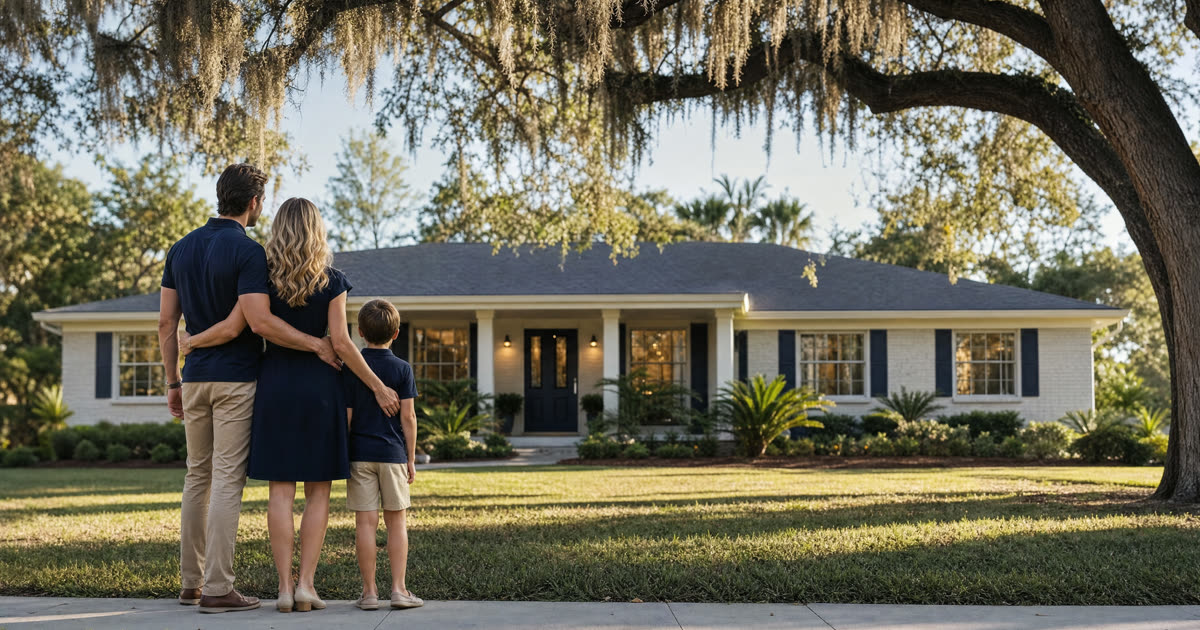
One Town, Two Very Different Homes
Alicia is 31, a first-time buyer, and she has spent three weekends driving the same stretch of South Daytona trying to make up her mind. On one side of the equation: a brand-new three-bedroom infill home, crisp drywall, a builder warranty, and a price that feels almost too good for 2026. On the other side, three streets over, a solid 1960s concrete-block house with a big lot, mature oaks, and Old-Florida bones that a good inspector might either bless or flag. She asked me which one she should buy. My answer, as both an attorney and a REALTOR®, is that neither choice is automatically right. The town, the product, and the fine print all matter enormously, and that is exactly what this guide walks through. Alicia is a composite example rather than an actual client, but her question is one I hear in very real form every week.
South Daytona: Small City, Distinct Identity
South Daytona sits between Daytona Beach to the north and Port Orange to the south, hugging the western bank of the Halifax River. Its footprint is compact, roughly two square miles, which means it never sprawls in the way its neighbors do. That small scale is a feature for buyers who want a neighborhood that actually feels like one. Niche ranks South Daytona seventh among Volusia County communities for livability, and local real estate professionals consistently note that the buyers arriving here tend to be first-time purchasers or people deliberately trading down in square footage in exchange for community feel and location.
Reed Canal Park anchors the southern end of the city with kayak launches, a canal loop, and shaded picnic areas that feel genuinely used rather than merely maintained. The Halifax riverfront offers boat ramps and water views that rival anything in the broader metro area. Ridgewood Avenue, the city's main commercial corridor, carries a mix of locally owned restaurants, small shops, and service businesses that give South Daytona an identity separate from the tourist energy of the beachside. Proximity to I-95 and US-1 means commutes to Port Orange, Daytona Beach, and even Ormond Beach or Palm Coast are practical without living on a highway.
The Market Reality: What the Numbers Actually Say
According to the Zillow Home Value Index for July 2026, the typical home value in South Daytona is $250,000, up 1.5 percent over the prior year and up 19.0 percent over five years. That five-year appreciation is meaningful for a first-time buyer building equity, and the modest one-year gain signals a market that has stabilized rather than overheated. Compare that to Daytona Beach, where the typical value is $253,000 but has declined 3.1 percent over the past year, or Port Orange at $340,000, also down 3.1 percent year over year. Volusia County as a whole sits at a typical value of $327,000, which means South Daytona remains notably more accessible than the county median while still trending positively.
For Alicia, who is watching her budget carefully, the gap between South Daytona and Port Orange is not trivial. A lower purchase price means a smaller loan, a lower monthly payment, and more room to absorb the ownership costs that Florida inevitably delivers.
Infill New Construction: What Builders Are Actually Offering
South Daytona's older housing stock, primarily mid-twentieth-century block construction on established lots, has created pockets where tear-downs or vacant infill parcels attract smaller builders. These are not master-planned subdivisions with a clubhouse and a model home village. They are individual builds or small clusters of three to ten homes dropped into existing neighborhoods, which changes the buyer experience considerably.
The advantages are real. A new home in South Daytona typically brings modern electrical panels, updated plumbing, impact-resistant windows (often required under current Florida Building Code), and energy-efficient HVAC systems. Builders of new residential construction are required under Florida law to provide a statutory warranty: one year on workmanship and materials, two years on major systems including electrical, plumbing, and HVAC, and ten years on structural defects, per Florida Statute Section 553.84 and the implied warranty framework developed through Florida case law. Buyers should understand, however, that the builder's contract is drafted to favor the builder. Allowable substitutions, limited liability clauses, and binding arbitration provisions are common, and reviewing that contract with an attorney before signing is not optional caution, it is basic protection.
A few other infill-specific watchpoints: confirm that the builder pulled proper permits with the City of South Daytona and that all inspections were completed, not merely scheduled. Ask whether the lot was previously surveyed for environmental concerns, and verify that the new home's elevation certificate has been issued, because that document will drive flood insurance costs directly.
Want answers for your exact situation? Get 30 minutes with an Attorney & REALTOR®. It's free.
Book a Free Strategy Call or call/text 386-273-3636The 1960s Block Home: Inspection, Insurance, and the Real Cost of Old Florida
Alicia's alternative, the older block home three streets over, carries its own set of considerations. Concrete-block construction is genuinely durable, and many mid-century South Daytona homes have outlasted wood-frame houses built decades later. But Florida's insurance market has become unforgiving about age-related factors. Roof condition and age are scrutinized closely by carriers. Electrical panels of certain older types, knob-and-tube wiring or specific breaker brands, can trigger coverage refusals or premium surcharges. Plumbing materials in homes of that era vary widely.
A thorough home inspection is non-negotiable, and in Florida the contract form most commonly used (the FR/BAR As-Is Residential Contract for Sale and Purchase) gives buyers an inspection period during which they may cancel for any reason and recover their deposit. That window is a buyer's most important contractual right, and using it fully, meaning actually hiring a licensed inspector and reading the report before the period expires, is essential. For a home of this age, a wind mitigation inspection and a four-point inspection are also likely required by any insurer before coverage is bound.
Flood Zones, the Halifax River, and What Elevation Means for Your Wallet
Both properties Alicia is considering sit within blocks of Halifax River corridors and canal systems that place portions of South Daytona in FEMA Special Flood Hazard Areas. Flood insurance is entirely separate from homeowners insurance and is governed by the National Flood Insurance Program, though private market options have expanded in Florida in recent years. The premium Alicia would pay is determined not by the list price of the home but by its elevation relative to the Base Flood Elevation shown on the FEMA Flood Insurance Rate Map, the construction type, and the coverage amounts selected.
The new construction home almost certainly has a higher elevation than the 1960s home, because current building codes require finished floor elevations that meet or exceed Base Flood Elevation, often with additional freeboard. That engineering difference can translate to meaningfully lower annual flood insurance premiums. Alicia should request the elevation certificate for both properties before making any final decision, and she should obtain flood insurance quotes for each, because the difference in annual cost can affect how competitive each purchase price truly is.
The Attorney-REALTOR® Read: Documents You Must Review
Whether the home is new or old, several document reviews belong in every transaction in this market. If either property has a homeowners association, Florida Statute Section 720.401 requires that a buyer receive the HOA documents, including declarations, rules, and the most recent financials, before or at contract execution, with a right of rescission after delivery. The HOA estoppel certificate, required under Florida Statute Section 720.30851, confirms the current fee status and any outstanding violations or special assessments. For any condominium unit, the parallel requirements under Florida Statute Chapter 718 apply, and buildings of three stories or more face additional milestone inspection and structural reserve funding obligations under legislation enacted after the Surfside collapse.
On the title side, buyers in Florida customarily pay for the owner's title insurance policy in most Volusia County transactions, and documentary stamp taxes on the deed are calculated at $0.70 per $100 of purchase price. Those are costs to budget from the beginning, not surprises at closing.
What Alicia Chose
After reviewing both options with care, Alicia chose the new construction home. The ten-year structural warranty, the modern electrical and plumbing systems, and the higher base flood elevation that produced a more manageable flood insurance quote were the deciding factors. She was also candid about her bandwidth: as a first-time buyer with a full-time career, she did not want to manage deferred maintenance in year one. The 1960s block home had real appeal, and its lot was genuinely larger, but the four-point inspection revealed an aging roof and an electrical panel that two insurers had already flagged. Negotiating those issues in an as-is contract while also competing on price felt like more friction than the deal was worth at this stage of her life.
She did not pick new construction because it was new. She picked it because, after looking at the elevation certificate, the builder warranty, the flood insurance quotes, and the builder contract (reviewed by an attorney before she signed), the total cost of ownership over five years was clearer and more predictable than the alternative. That kind of disciplined comparison, property by property and dollar by dollar, is exactly how a first-time buyer builds wealth in a market like South Daytona rather than getting surprised by it.
Ready to Compare Your Options in South Daytona?
South Daytona's infill new construction market moves quickly, and the older resale homes that represent real value need a practiced eye to evaluate fairly. As an Attorney and REALTOR® with Realty Pros Assured in Ormond Beach, I work with buyers across Volusia and Flagler counties, from South Daytona and Port Orange to Ormond Beach, New Smyrna Beach, Palm Coast, and DeLand, helping them read contracts, understand flood exposure, evaluate builder agreements, and close with confidence. Visit arthursimpson.com to explore more guides in this series or to schedule a conversation about your specific search.
Arthur Simpson, Esq., CIPS, is a Florida attorney and REALTOR® (sales associate) with Realty Pros Assured in Ormond Beach, Florida, and the founder of Truestead Law, LLC. This article is for informational purposes and does not constitute legal advice. Consult a licensed attorney and your own financial advisors regarding your specific transaction.